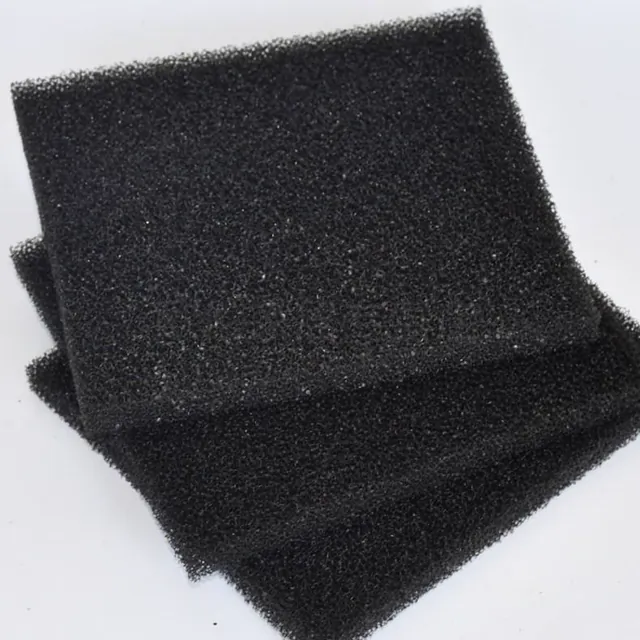
Activated Carbon Foam Filter Media

Activated carbon foam filter media uses flexible open-cell polyurethane foam as the carrier for powdered activated carbon. It is supplied as sheets or custom-cut pads for air-purifier and ventilation odor-control components; it is not a rigid honeycomb activated carbon block.

Form
Foam sheet / Cut pad
Material
Polyurethane foam with powdered activated carbon
Series range
10–60 PPI; typically ≥50% activated carbon
Customization
Pore density, thickness, dimensions and flame-retardant option

Catalog values are product-series references. Final values will be confirmed for the selected model and order specification.

Series reference

Procurement Specifications

Use these series values to screen sheet and cut-pad requirements. Final combinations are confirmed for the selected model and order document.

Foam base
Polyurethane
Activated carbon source
Wood, coal or coconut shell
Activated carbon content
Typically ≥50%
Thickness
3–100 mm
Sheet dimensions
1000 mm standard width; 1200 mm maximum width; 2000 mm length
Pore-density series
10–60 PPI
Pressure drop
≤35 Pa at 10 mm and 1.0 m/s (catalog reference)

How the foam and carbon work together

The foam provides a porous support, while the activated carbon is the gas-phase adsorption medium. Selection depends on the target odor or gas and the airflow conditions.

For a comparison of nonwoven media, ACF felt and carbon foam, see our activated carbon media selection guide.

How to select PPI and thickness

PPI means pores per inch and is used to describe the pore density of the foam. The available series covers 10–60 PPI. Existing catalog options include 20, 30 and 35 PPI and 3–100 mm sheet thickness; confirm the required combination for the selected model.

PPI describes the foam structure, not a filtration efficiency class or a guaranteed odor-removal performance. When comparing specifications, check the media thickness and airflow conditions alongside the pore density.

Check the available installation space, cut dimensions, airflow conditions, target odor or VOC, and any flame-retardant requirement. Final specifications are confirmed for the selected model.

Applications

Typical applications include:

  • Filter media for industrial exhaust-air treatment
  • Household air purifiers
  • Cooking-fume filtration systems
  • Refrigerator odor-control filters

Select the foam grade and filter construction for the target gas or odor, airflow and installation conditions.

Information needed for product selection

Start with your application or a photo of the existing foam. You do not need a complete specification to contact us. The following details are useful for the follow-up discussion; share what you already know.

  • Pore density (PPI), if known
  • Thickness and cut dimensions
  • Target odor or VOC
  • Flame-retardant requirement and installation method

Checking a replacement foam sample

Match the required dimensions and installation arrangement as well as the PPI. A similar-looking foam is not enough to confirm that the material meets the existing specification.

Keep the sample identification with its specification and compare performance under the same test conditions. The specification and sample-evaluation guide explains what to clarify before approving a replacement. For supply dimensions, see rolls, sheets and cut parts.

How should carbon foam pad dimensions be checked?

Agree on the measurement method before setting a pass/fail tolerance. Keep the pad's measured thickness separate from the gap available in the holder. A fit check in the equipment and a thickness measurement answer different questions.

  • Identify the approved foam sample and the drawing revision.
  • Mark length, width, thickness, holes and any critical edges, with units.
  • Agree on the instrument, measurement locations, sample condition and tolerances for the selected pad.
  • Record how the pad is supported and held in the actual assembly; do not infer the required fit from PPI alone.

ISO 1923 addresses equipment and procedures for measuring linear dimensions of cellular plastics and rubbers. It is a general reference, not a claim that this product has been tested to that standard or a substitute for an agreed inspection method.

What should be agreed before packing foam pads?

Ask for the proposed packing arrangement and confirm whether it is suitable for the selected foam. Do not assume compression packing is acceptable simply because the material is flexible.

Agree on pack identification, quantity by size and any sample preparation needed before incoming measurements are taken. If a recovery period is required after unpacking, have it specified for the proposed material rather than choosing an arbitrary waiting time.

Use the packing and receiving checklist to keep the purchase specification, sample and delivery checks aligned. No universal dimensional tolerance, recovery time or carbon-release limit is stated here; any such requirement must be agreed before an order.

Buyer questions

Activated Carbon Foam FAQ

Short answers based on the current factory catalog and confirmed product structure.

Which PPI and sheet sizes are available?

The series covers 10–60 PPI. Sheets are 2000 mm long, with a standard width of 1000 mm and a maximum width of 1200 mm. Existing catalog sheet thickness is 3–100 mm; confirm the required PPI and thickness combination for the selected model.

Can the foam be supplied as cut components?

Yes. The available format includes foam sheets and custom-cut pads. Please provide the cut dimensions, thickness, quantity and installation drawing when available.

Is it used for particle filtration?

Activated carbon provides odor adsorption, while the foam structure can intercept dust. A separate particulate pre-filter may still be needed, depending on the complete filter design.

What should I send for product selection?

Start with your application or a photo of the existing foam. If known, add the PPI, thickness, cut size and quantity. We can clarify the remaining specifications with you.

Send Your Requirement

Leave one valid contact detail so we can reply. The current product is filled in below and can be edited. Other information is optional.

Have a drawing or sample photo? Send it to sales@junkangfilter.com or use WhatsApp. This form does not upload files.

What happens after your inquiry?
  1. Send the requirement you already have.
  2. Review the material, dimensions and specification with us.
  3. Agree sample or prototype arrangements.
  4. Approve the sample against the agreed requirements.
  5. Confirm the bulk quotation and supply arrangements.

Sample charges, minimum order quantity and lead time are confirmed for your project.