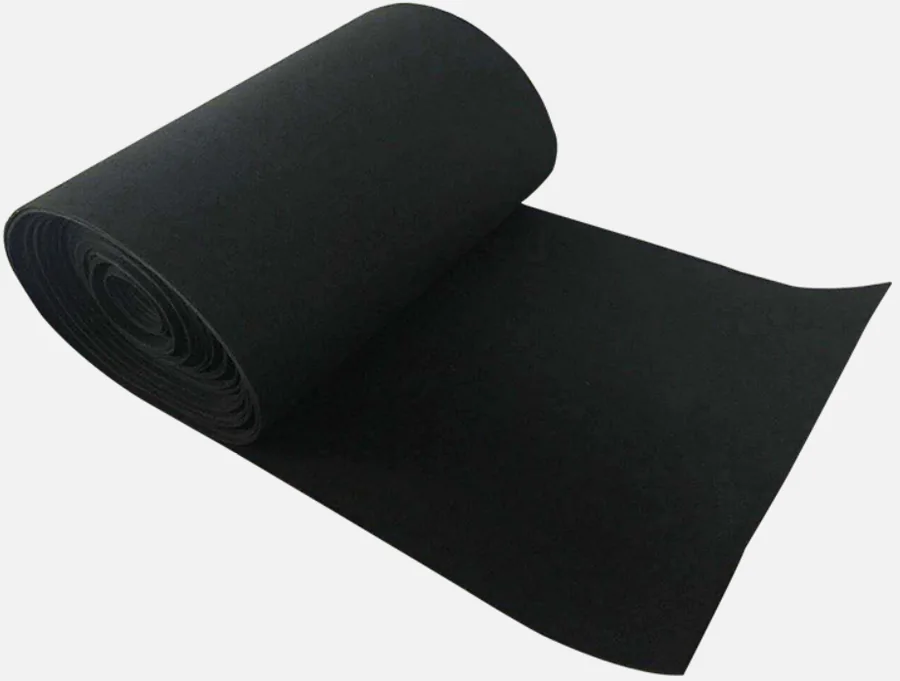
Activated Carbon Rolls, Sheets or Cut Parts?
Start with one practical question: will you cut the media yourself, or do you need pieces cut to your drawing? Consider rolls for in-house cutting, sheets for working with flat stock, and cut parts when you want the supplier to provide the specified outline. Confirm the material separately: a supply format is not a material specification.
- Rolls
- Plan for unwinding and cutting in-house
- Sheets
- Specify flat dimensions and any further cutting
- Cut parts
- Provide the finished outline and critical dimensions
- Before ordering
- Confirm the material, sample and packaging
This guide compares supply formats, not adsorption performance. Available formats and processing options must be checked for the selected material and drawing.
When to consider rolls
Consider roll media if you have equipment to unwind and cut it. Before requesting a roll size, check what your equipment can handle and how you will cut the required parts from the roll.
- State the required roll width and length, with units.
- Include any limits on roll diameter, core size or handling weight.
- Provide the finished part dimensions and quantity if you want to compare roll supply with pre-cut pieces.
A lower price per square meter does not, by itself, establish a lower finished-part cost. Compare material use, cutting, handling and packing for the same requirement.
When to consider sheets
Consider sheets when you prefer flat pieces for handling or further cutting. Make clear whether the sheet itself is the finished component or stock from which you will cut smaller parts.
- Specify length × width and identify which dimension is which.
- State the required thickness or provide the existing material specification.
- Give the sheet count and describe any further cutting or assembly.
Do not assume that a nominal sheet size will fit a holder. Identify the actual component dimensions and any fit requirements on your drawing.
When to consider cut parts
Consider cut parts when you want the supplier to provide pieces to a specified outline. A circle, rectangle or shaped insert needs a clear drawing; a photograph alone does not define its dimensions.
- Show the outline, holes, slots and critical dimensions, where applicable.
- Specify required tolerances and the drawing revision.
- State the quantity for each size or shape and explain how the part will be fitted.
A cut part is not necessarily a die-cut part. Agree on the cutting method and achievable tolerances with the factory before ordering. Cutting to shape does not include a frame, adhesive or finished filter unless these are specified and agreed.
Confirm the material before the format
“Carbon sheet” describes neither the full construction nor the required performance. Send the existing material code or specification, explain the application and identify any test requirements.
Do not treat activated carbon nonwoven, sandwich carbon nonwoven, activated carbon fiber cloth or felt, and activated carbon foam as interchangeable simply because they can be described as sheets or pads.
Use the activated carbon filter media overview to start a material discussion. If you are sourcing white synthetic media instead, use the white pre-filter media specification checklist.
Make dimensions and quantities unambiguous
Put units beside each dimension: for example, mm for a cut part and m for roll length. Do not send a bare number such as “300 × 300” without units. Identify thickness separately from length and width.
State whether the order quantity means rolls, sheets, pieces or square meters. For a rectangular piece, area equals length × width, with both dimensions expressed in meters if the result is in m².
Finished-piece area is not the same as the raw material required for production. Ask for a quote for the actual piece count and drawing rather than assuming an area calculation includes cutting waste.
Check the sample and packing before ordering
Agree on a sample and the checks you need before approving production. These may include dimensions, fit in your assembly, and testing against your stated application requirements. Appearance or fit alone does not verify filtration or adsorption performance.
- Confirm whether sheets or parts should be packed flat and how many belong in each pack.
- Identify any labeling, separation or protection requirements.
- Ask for the proposed packed dimensions and weight before comparing freight quotes.
To begin, send your application, material reference, preferred format, dimensions with units, quantity and drawing or sample details. Junkang can review the request with the factory; the final specification and scope of supply need to be agreed before an order.
How many square meters are in 1,000 cut pads?
For rectangular pads, convert both dimensions to meters, multiply them, then multiply by the piece count. Thickness is specified separately; it is not part of the area calculation.
Illustrative example, not a product specification: a 300 × 300 mm pad measures 0.3 × 0.3 m, so its area is 0.09 m². A quantity of 1,000 pads has a total finished-piece area of 90 m², not 100 m².
That is the net area of the finished rectangles, not the roll area needed to produce them. Cutting layout, edge trim, spacing and rejected pieces can change the raw-material requirement. Do not assume that a 90 m² roll order will deliver 1,000 usable pads.
For circles or parts with holes, ask whether the supplier quotes by finished-piece count, net shape area or allocated cutting area. These are different quantity bases.
How do you compare a price per m² with a price per piece?
First match the material specification, thickness, finished dimensions and required quantity. Then compare the total cost of obtaining that quantity of acceptable finished parts—not just the two unit prices.
- Roll option: include the purchased roll area, your cutting and handling costs, and any tooling or setup costs.
- Cut-part option: multiply the quoted piece price by the required count and add any separately quoted cutting or tooling charges.
- Both options: check packaging, freight, delivery terms and any excluded charges. Use the same currency and destination.
For the 300 × 300 mm example, dividing a piece price by 0.09 gives a price per m² of finished-pad area. This is a unit conversion only: it does not remove cutting costs already included in the piece price or account for waste when buying rolls.
Ask what each quotation includes before adding charges, so cutting or packing is not counted twice. Neither rolls nor cut parts are automatically the lower-cost choice.
Will cutting the media reduce shipping costs?
Not necessarily. Compare the proposed package count, external dimensions and gross weight for each format. A smaller piece size alone does not establish a lower freight charge.
Depending on the service, freight pricing may take both actual weight and dimensional weight into account. Confirm the applicable calculation and all charges with the carrier for the actual shipment; do not use one dimensional-weight divisor for every service.
See DHL's explanation of chargeable weight. It explains the general principle, not a shipping quotation for Junkang products.
Which product should the quotation refer to?
Specify the material as well as the format. For a PET polyester fiber carrier loaded with powdered activated carbon, see polyester-based activated carbon filter media. For our separate nonwoven product, see activated carbon nonwoven fabric.
Send the material reference, finished dimensions and actual piece count through the inquiry form below. If you are comparing roll and cut-part supply, ask for both options against the same requirement.
Area units follow the NIST guide to SI units of area. The worked example above is arithmetic, not a confirmed cutting yield or available product size.
Updated October 5, 2026.
What should the packing and receiving specification include?
Agree on how the delivery will be identified and checked before placing the order. The receiving record should refer to the same material, drawing and accepted sample as the purchase order, rather than just a description such as “black filter pads.”
- Identification: specify the material or part reference, drawing revision, size and quantity to appear on each pack. Agree on a batch reference if traceability is required.
- Separation: state whether different sizes or revisions must be packed separately and whether faces or orientation need marking.
- Packing condition: agree on flat or rolled packing where suitable for the material. Do not assume that compression, tight rolling or vacuum packing is acceptable.
- Receiving method: define sample selection, preparation, measurement method, tolerances and any required appearance or performance checks.
These are requirements to agree with the supplier, not a claim that every packing or inspection option is available. Foam and rigid modules need their own review; the word “roll” in this guide does not establish roll availability for a particular material.
How should a receiving discrepancy be recorded?
Record the pack or batch reference, the required value, the observed result and the method used. Keep photographs of the label, packaging and affected part with that record. A bare statement such as “too thin” does not show whether the material, packing condition or measurement method differs from the agreed specification.
For example, distinguish a thickness measured on an unpacked sample from a gap measured in the installed holder. Use the agreed preparation and measurement conditions when comparing the delivery with the approved sample; do not treat a photo or successful fit as proof of adsorption performance.
See the product-specific checks for carbon foam pad dimensions and plastic honeycomb module interfaces. For textile-based white media, see the thickness measurement note.