Quick answer
What should a white filter media RFQ include?
To start, share your application or an existing material reference. Add the supply format if you know it; we can clarify the rest together.
Example first message: “We are looking for white polyester pre-filter media for [application], supplied as [rolls / sheets / cut pads]. Could you help us select a suitable specification?”
The detailed checklist below is optional. Use it when preparing a quotation or sample review, not as a requirement before contacting us.
Color and apparent thickness are not enough to identify filtration performance. Do not assume that two visually similar media products are interchangeable.
Copyable checklist
White pre-filter media RFQ checklist
Optional reference for follow-up. Use any items that are already available; you do not need to complete the checklist before contacting us.
Application: [equipment and installation position]
Supply form: [bulk roll / sheet / cut pad]
Dimensions: [required finished pad L × W × T, or roll width, length and media thickness; label any nominal filter or frame measurements separately]
Base fiber / material: [state if specified; otherwise confirm for the proposed model]
Current grade or specification: [required standard and class, or existing datasheet reference, if available]
Trial quantity: [quantity for each size]
Regular order quantity: [estimated quantity]
Converting or packing: [cutting, lamination, labeling or packing request]
Reference material: [drawing / label photo / datasheet / physical sample reference, if available]
Use any details you already have in the Requirement field on the white pre-filter product page. Mark unknown items “to confirm”. This checklist is not a separate form. For drawings and photos, use the email or WhatsApp contact shown on that page; the inquiry form does not upload files.
Step 01
State the application and installation position
Begin by explaining where the material will be installed in the air-handling or filtration system. “White filter cotton” is too broad because similar-looking media can be intended for different filtration stages.
- HVAC or AHU air intake
- Ventilation equipment inlet
- First-stage filter before a downstream filter
- Media for local converting or assembly
Also describe the downstream stage when known. A particulate pre-filter installed before an activated carbon adsorption stage has a different function from the carbon media itself.
Step 02
Choose bulk rolls, sheets or cut pads
The most suitable format depends on the buyer’s converting process, order volume, shipping constraints and required finished size. Final feasibility should be confirmed before ordering.
Step 03
Define dimensions without ambiguity
Use one unit system consistently and label each dimension. For pads, write length × width × thickness. For rolls, state the roll width, roll length and media thickness. If more than one size is required, list the quantity for each size separately.
For replacement pads, state whether the dimensions describe the required finished media size, a nominal filter size or measurements of the frame or holder. If the required cut size is unclear, attach a drawing or a labelled photo and identify which dimensions still need confirmation. Do not assume a standard allowance between the filter size and the media cut size.
A drawing is especially useful when the media includes holes, notches, adhesive areas, laminated layers or an unusual outline. Do not rely on a product photo alone to communicate scale.
Optional installation reference
Which face should point upstream, and how is the pad supported?
Follow the airflow marking and installation instructions for the selected media and equipment. If the two faces differ or the existing pad has a backing layer, confirm the inlet face rather than deciding from color or appearance.
Review the holder, retaining support and edge seal as part of the replacement. A pad's dimensions alone do not establish that it will stay in place or prevent air from bypassing the media. A photo of the installed pad and holder can help with the discussion; share it if available, and we can clarify the remaining details together.
Measurement note
Why can two thickness measurements differ?
Textile thickness depends on the pressure applied during measurement. A caliper reading without a stated method is not directly comparable with a result measured under a specified pressure. Keep the measurement conditions with the value when comparing a supplier sample and an incoming delivery.
ASTM D1777 explains the effect of measurement pressure on textile thickness. ISO 9073-2 covers nonwoven thickness under specified pressure. These are general measurement references, not claims that Junkang's white media has been tested to either standard.
- Identify the proposed material and the method or standard used.
- Record the measurement pressure and other conditions required by that method.
- Agree on the tolerance and sampling procedure before a bulk order.
- State the available holder gap separately from the measured material thickness.
A nominal thickness is not an instruction to compress the material into any smaller gap. Confirm the fit with the equipment design, and keep filtration-performance requirements separate. For delivery labels and discrepancy records, see the packing and receiving checklist.
Step 04
Share the existing grade or technical reference
If you are replacing an existing material, send the current datasheet, label, purchase specification or test requirement. Include any stated filter grade, pressure drop, arrestance requirement or operating temperature limit that must be reviewed.
If no formal specification exists, describe the current product and intended application rather than guessing. The polyester pre-filter media product page shows supply formats and the information needed to review a proposed model; it does not assign a verified filter class to the pictured material.
Material identity
What material does Junkang's white pre-filter media use?
Junkang's white pre-filter media is made from polyester fibers across the available thicknesses and basis weights. If you are replacing an existing material, send its specification or a sample photo so we can review the construction and fit.
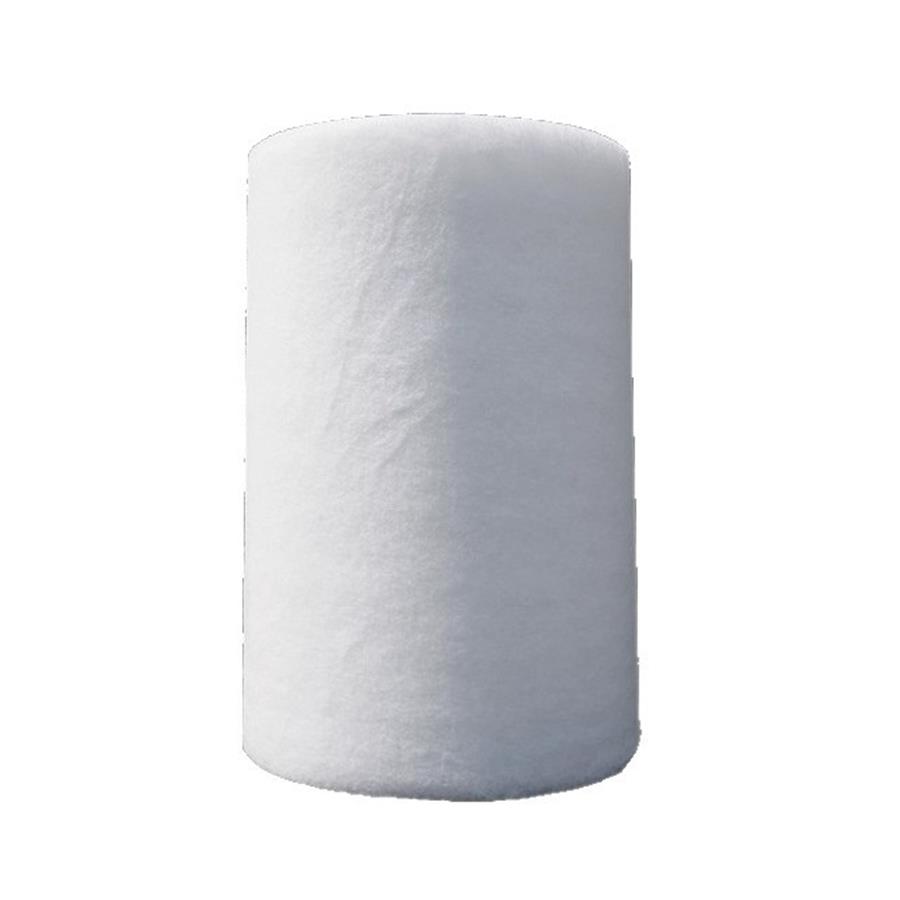
See a common specification example: 5 mm thick, 110 g/m² polyester pre-filter media, shown with its corresponding product photo. Other order specifications are discussed against your requirements.
Fiber type, thickness and basis weight alone do not establish a filtration class or pressure-drop value. See the polyester pre-filter product FAQ and confirm any required test evidence before approving a replacement. Do not identify an unknown existing material from color alone.
Before comparing quotations
How do you compare white filter media specifications?
Start with the test method and the item tested, not just the grade or price. A material sample and a complete filter are different test items. Ask which construction the report covers before using its results to approve your own filter design.
Keep G2, ISO 16890 and MERV in context
Do not use an older catalog's G2 label as proof that the current proposed model meets that class. Do not translate it into an ISO 16890 class by calculation: Eurovent explains that EN 779 and ISO 16890 classifications are not directly convertible. MERV is a separate reporting system based on an ASHRAE particle-removal test method; a G2 label is not evidence of a particular MERV rating.
Compare pressure drop at stated conditions
To compare pressure-drop values in pascals (Pa), check the airflow conditions. Ask for the test airflow or face velocity, sample dimensions and mounting arrangement. Separate the initial resistance from the stated final or replacement resistance. A lower number without comparable conditions is not enough to select a replacement.
For the unit conversion, a worked airflow example and the difference between face and media velocity, see the filter media face-velocity and pressure-drop guide. It explains the calculation without assigning a safe operating speed or predicting resistance for a proposed material.
- Identity: record the supplier's model and the tested material or complete filter.
- Method: retain the standard, edition, report reference and stated classification.
- Conditions: record airflow, test dimensions and whether the value is initial or loaded.
- Decision: flag missing information instead of assuming two quotations are equivalent.
For supply formats and the current evidence boundary, see the polyester pre-filter media product page. A project that requires a specific tested rating needs matching documentation for the proposed product.
Before a bulk order
What should a sample approval record include?
Agree on what will be checked before the sample is supplied. Keep the accepted sample reference, dimensions, tolerances and any required test evidence together, so a later order can refer to the same specification.
- Material reference and supply format: roll, sheet or cut pad.
- Dimensions and agreed tolerances, including the method used to measure thickness.
- Fit in the intended holder, including support and edge sealing.
- Required performance evidence and any checks still outstanding.
This is a purchasing checklist, not a prescribed test procedure. Visual inspection can help check form and fit, but it does not establish filtration efficiency. A sample that looks suitable is not proof of an unverified filter class.
Step 05
Use photos and samples as supporting evidence
Photos can show surface texture, color, backing, layer construction and installation position. A physical sample can support a more detailed factory evaluation. Neither should be treated as a substitute for the required technical specification.
- Overall product and installation photo
- Close-up of both sides of the media
- Label, model number or current datasheet
- Sample dimensions and measured thickness
- Airflow direction, if the sides differ
- Trial and regular-order quantities
Buyer questions
Frequently asked questions
What information should be included in a white pre-filter media RFQ?
To start, share the application or an existing material reference, plus your preferred supply form if known. Dimensions, quantity, filter class and test requirements can be clarified during the follow-up. Use the detailed checklist when preparing a quotation or sample review.
Should I request rolls, sheets or cut pads?
Choose rolls when your factory will convert the material, sheets when local handling or assembly is easier, and cut pads when the finished dimensions are already known. Final format depends on your process and factory feasibility review.
Can a photo replace a filter media specification?
No. A photo helps identify construction and application, but it normally cannot confirm grade, thickness, pressure drop or other requirements. Combine it with dimensions, labels, drawings, existing data or a physical sample where possible.
Is white pre-filter media the same as spray booth ceiling media?
No. General white synthetic pre-filter media and spray booth ceiling media serve different installation positions and selection requirements.
Do all white synthetic filter media products have the same performance?
No. Appearance alone does not establish grade or performance. Confirm the selected model and agreed specification before ordering.
Technical references
These sources explain general classification and test principles. They are not certificates for Junkang products and do not assign a rating to the materials shown on this site.