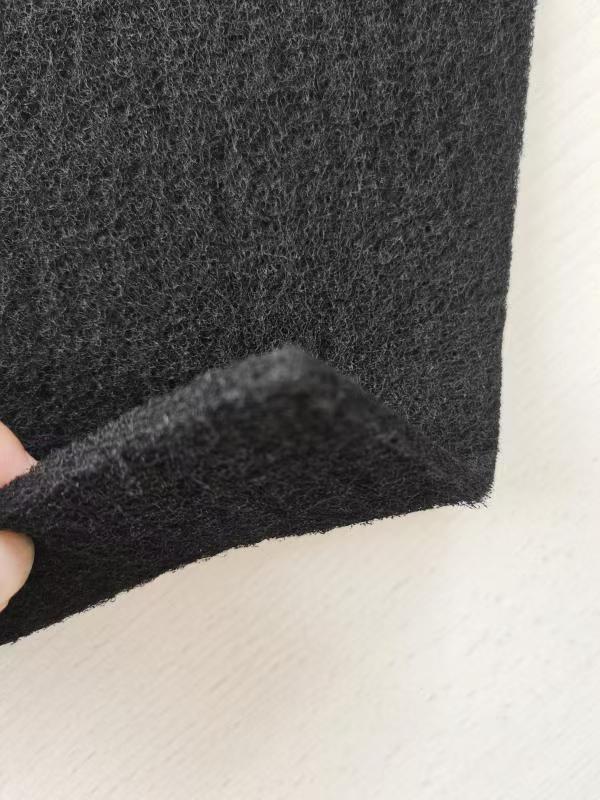
Carbon-Impregnated Polyester Filter Media

Carbon-impregnated polyester filter media, also called fibrous activated carbon filter media, uses a PET polyester fiber base loaded with powdered activated carbon. It is supplied in rolls, sheets and cut parts for air-filtration and odor-control components; it is not activated carbon fiber (ACF) cloth or felt.

Form
Roll / Sheet / Cut part
Material
PET polyester fiber base with powdered activated carbon
Series range
1–30 mm thick; width up to 2000 mm; activated carbon content ≥50%
Customization
Width, thickness, roll length and cut size

Catalog values are product-series references. Final values will be confirmed for the selected model and order specification.

Series reference

Procurement Specifications

Use these values to screen roll, sheet and cut-part requirements. Range endpoints and roll-length tiers are not freely interchangeable; final combinations are confirmed by model.

Fiber base
PET polyester
Activated carbon source
Wood, coal or coconut shell
Activated carbon content
≥50%
Thickness
1–30 mm
Maximum width
2000 mm
Catalog roll length
100 m at 1–4 mm; 60 m at 5–10 mm; 20 m at 15–20 mm
Pressure drop
≤80 Pa at 5 mm and 1.0 m/s (catalog reference)

Polyester-based carbon media, ACF felt or carbon foam?

The PET fibers support powdered activated carbon; they are not themselves activated carbon fibers.

Activated carbon fiber (ACF) felt uses activated carbon fibers, while activated carbon foam filter media uses an open-cell polyurethane foam carrier. Compare the material structure and required component format before requesting a replacement.

For the other available structures and supply formats, see our activated carbon filter media overview.

Specify rolls, sheets or cut parts

Start with your application or an existing material reference, plus any dimensions or quantity you already know. You do not need a complete specification to contact us; we can clarify the rest during quotation and sample review.

Keep roll area and finished-piece count separate when requesting a price. For example, 1,000 rectangular pieces measuring 300 × 300 mm have a net area of 90 m²; this does not include cutting waste or establish how much roll stock is needed. This is an arithmetic example, not a confirmed cut size.

Use the roll-versus-cut-part quotation guide to compare per-m² and per-piece prices, cutting charges and packaging on the same basis.

For rolls, state the required width and roll length, with media thickness listed separately. For sheets or cut parts, provide the finished length, width and thickness. Include a dimensioned drawing for shaped parts, holes or cutouts.

During the follow-up review, we can clarify the equipment, target odor or gas, airflow conditions and any lamination or flame-retardant requirement. If you have an existing material specification or sample, include it for comparison. Final dimensions, construction and suitability are confirmed for the selected model.

How to read the catalog values

The listed pressure drop of ≤80 Pa is tied to a 5 mm specimen and an air velocity of 1.0 m/s. Keep those conditions with the value when comparing specifications; do not treat it as a result for every thickness.

Confirm the mass basis and calculation method for the selected model's carbon-content figure before converting it to carbon mass per square meter. Our basis-weight and carbon-loading explanation shows which definitions are needed and includes an illustrative calculation.

Use the carbon media specification guide to check which details are needed for a meaningful comparison.

If your equipment specification gives airflow in m³/h, the face-velocity and pressure-drop guide shows how to relate it to a stated frontal area. The calculation does not predict resistance or validate a complete filter.

Applications

Typical uses include:

  • Workshop exhaust-air treatment where gas concentrations are low
  • Air-conditioning duct filtration
  • Household air purifiers

Composite filter media

The material can be combined with fine-fiber meltblown media or coarse pre-filter media for designs that need both particle filtration and odor control. The final construction and any test requirements are reviewed for the selected application.

OEM and conversion support

The catalog shows this material in roll and sheet form and describes its use in composites with other filter media. If your design needs a cut part or a composite layer, send the dimensions, layer arrangement and intended use so we can confirm the available supply options.

Send Your Requirement

Leave one valid contact detail so we can reply. The current product is filled in below and can be edited. Other information is optional.

Have a drawing or sample photo? Send it to sales@junkangfilter.com or use WhatsApp. This form does not upload files.

What happens after your inquiry?
  1. Send the requirement you already have.
  2. Review the material, dimensions and specification with us.
  3. Agree sample or prototype arrangements.
  4. Approve the sample against the agreed requirements.
  5. Confirm the bulk quotation and supply arrangements.

Sample charges, minimum order quantity and lead time are confirmed for your project.