How long does an activated carbon filter last?
An activated carbon filter does not have one universal service life. A responsible estimate cannot be made from length, width and thickness alone. Activated carbon has a finite adsorption capacity, and the useful service period depends on how the selected adsorbent and filter structure are challenged in the actual system.
The U.S. Environmental Protection Agency distinguishes saturation capacity from breakthrough capacity. For a working filter, the important endpoint is normally breakthrough: the point at which a significant concentration of the target contaminant begins to leave the carbon stage. That point depends on the project’s contaminant, loading conditions and acceptance criterion.
What determines activated carbon filter service life?
| Input | Why it matters | What the buyer should provide |
|---|---|---|
| Target gas, VOC or odor | Adsorbents do not have the same capacity for every chemical or mixture. | Chemical name, process source, odor description or available gas analysis |
| Inlet concentration | The concentration and any short-term peaks determine the contaminant load reaching the filter. | Typical and maximum concentration, with units and measurement method |
| Airflow and flow condition | Airflow affects how much contaminated air passes through the filter and the available contact time. | Air volume, face velocity or duct flow, with the operating range |
| Adsorbent and filter construction | Carbon type, carbon amount, media form, layer depth and flow distribution determine how much adsorbent is available and how air passes through it. | Existing filter specification, carbon reference, drawing, sample or construction details |
| Operating schedule | Total operating hours and process cycles affect cumulative contaminant loading. | Hours per day, days per week and continuous or intermittent operation |
| Temperature and humidity | These conditions can affect adsorption behavior and must be included in performance evaluation. | Normal range, maximum values and any recurring humidity or temperature peaks |
| Replacement endpoint | Service life cannot be compared unless the acceptable downstream condition is defined. | Required outlet concentration, breakthrough criterion, odor-control objective or applicable standard |
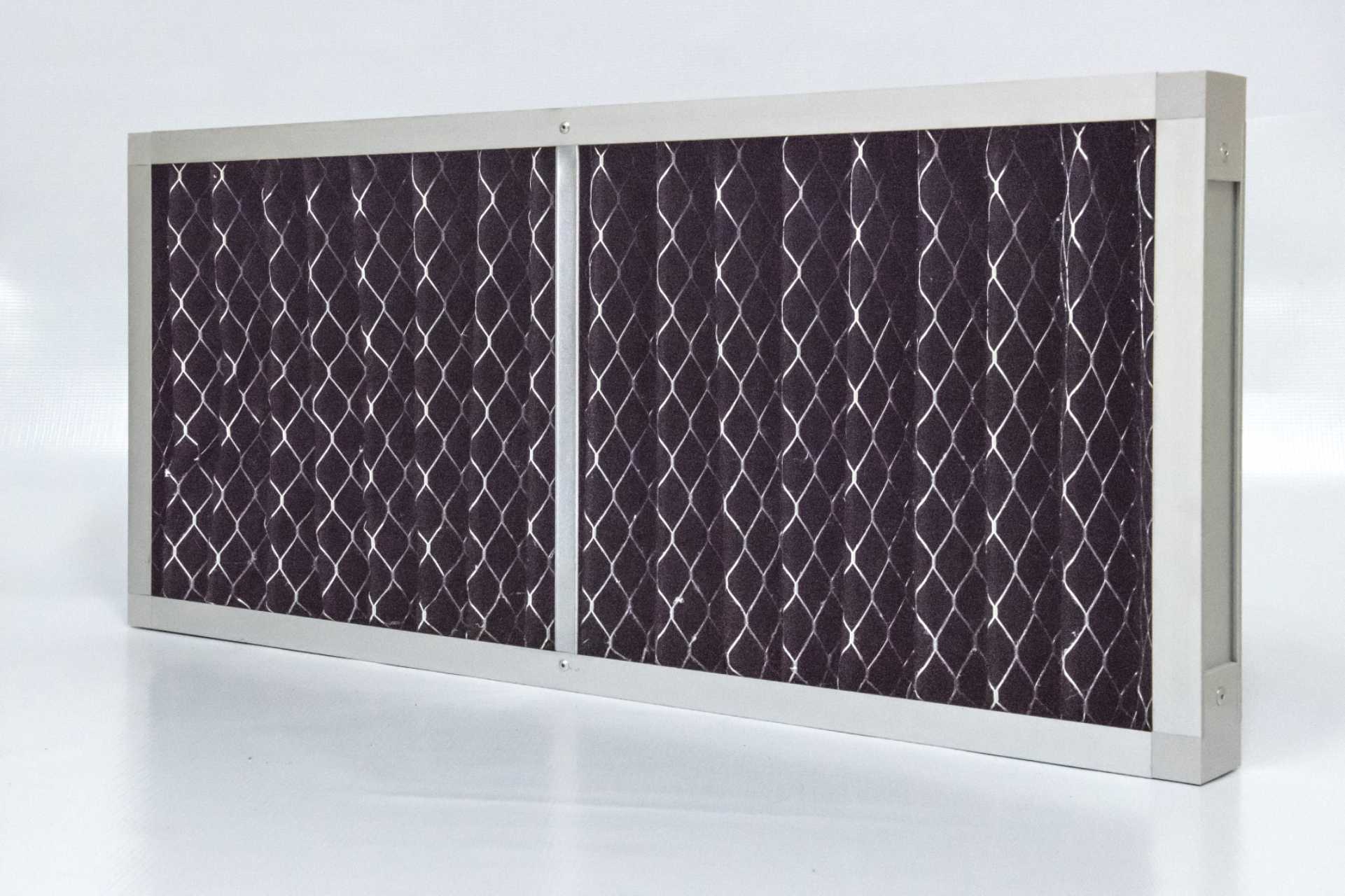
Physical fit and service-life performance are different questions
External dimensions, frame style and sealing details determine whether a replacement filter can fit the equipment. They do not establish how long the adsorption stage will control a particular gas or odor.
Two filters with the same outside dimensions can contain different carbon media, amounts of carbon, layer depths or flow paths. They can also be used at different airflow rates and contaminant concentrations. A dimensional drawing is therefore essential for manufacturing review, but it is only one part of a service-life discussion.
How should carbon media or filter samples be compared?
Compare samples under the same defined challenge conditions. Record the target gas, inlet concentration, airflow or face velocity, temperature, relative humidity, sample configuration and the downstream endpoint used to identify breakthrough.
ISO 10121-1 provides a laboratory method for evaluating gas-phase air-cleaning media. Its official scope notes that elevated challenge concentrations are used and that results are intended to compare like media configurations—not to directly predict performance in a real installation or compare unlike configurations as if they were equivalent. Complete devices require an appropriate device-level method.
For that reason, a laboratory result should be accompanied by its test conditions. A single efficiency percentage without the challenge gas, concentration, airflow, humidity, temperature, sample construction and test endpoint is not enough for a service-life comparison.
What should be monitored after installation?
The monitoring plan should be agreed for the application. EPA guidance lists outlet VOC concentration as a primary performance indicator and also identifies gas flow rate, inlet concentration, operating temperature, inlet moisture and pressure differential as relevant operating indicators.
- Define the target contaminant and acceptable downstream level.
- Record the initial operating conditions and filter installation date.
- Track outlet concentration or the project’s agreed breakthrough indicator.
- Record airflow, temperature, humidity, pressure differential and operating hours when relevant.
- Review process changes or concentration peaks that may alter loading.
- Set the replacement plan from validated operating data rather than an unsupported calendar promise.
Pressure drop remains useful for airflow and physical-loading checks, but it does not by itself prove that the adsorbent still has gas-phase capacity.
Information to send with an OEM inquiry
If you are sourcing activated carbon filter media or a custom finished filter, send the information already available. Unknown items can remain open for technical review.
- Application and equipment type
- Target gas, VOC, odor or process source
- Inlet concentration and measurement method, if available
- Airflow, face velocity or duct-flow range
- Operating hours, temperature and humidity
- Required media, sheet, cut part or finished-filter format
- Dimensions, frame, sealing and installation direction
- Current part number, drawing, sample or carbon specification
- Required outlet level, test method and quantity
Available project routes include flexible carbon media, flat-panel activated carbon filters, activated carbon bag filters and plastic honeycomb activated carbon filter modules. Final material selection, construction and performance requirements remain subject to model and factory feasibility review.
Frequently asked questions
How long does an activated carbon filter last?
There is no universal number of months. Service life depends on the target gas or odor, inlet concentration, airflow, carbon type and amount, filter configuration, operating hours, temperature, humidity and the agreed breakthrough or replacement criterion.
What does breakthrough mean in an activated carbon filter?
Breakthrough is the point at which a significant concentration of the target contaminant begins to leave the carbon stage. The project should define the downstream concentration or other endpoint used to identify that point.
Can two activated carbon filters with the same dimensions have the same service life?
Not necessarily. External dimensions confirm physical fit, but service life also depends on the adsorbent, carbon amount, media structure, airflow distribution, operating conditions, contaminant loading and performance endpoint.
Does pressure drop show when activated carbon is exhausted?
Pressure drop is useful for monitoring airflow and physical loading, but it does not by itself define gas-phase adsorption breakthrough. Outlet contaminant concentration or another agreed performance endpoint is needed for adsorption monitoring.
What information should a buyer provide for a carbon-filter service-life review?
Provide the application, target gas or odor, inlet concentration or available measurements, airflow, operating hours, temperature and humidity, filter dimensions and construction, current carbon or filter reference, required outlet level and applicable test or monitoring method.
Technical references and limitations
This guide explains general selection and monitoring principles. It does not provide a guaranteed life calculation for a specific Junkang product. A project-specific estimate requires confirmed media data, filter construction, operating conditions and a defined performance endpoint.