Why the media structure matters
Activated carbon filter media is used in air purifiers, HVAC systems, ventilation equipment and industrial filtration products for odor and gas-phase contaminant control. However, materials that all contain activated carbon can behave very differently during converting and assembly.
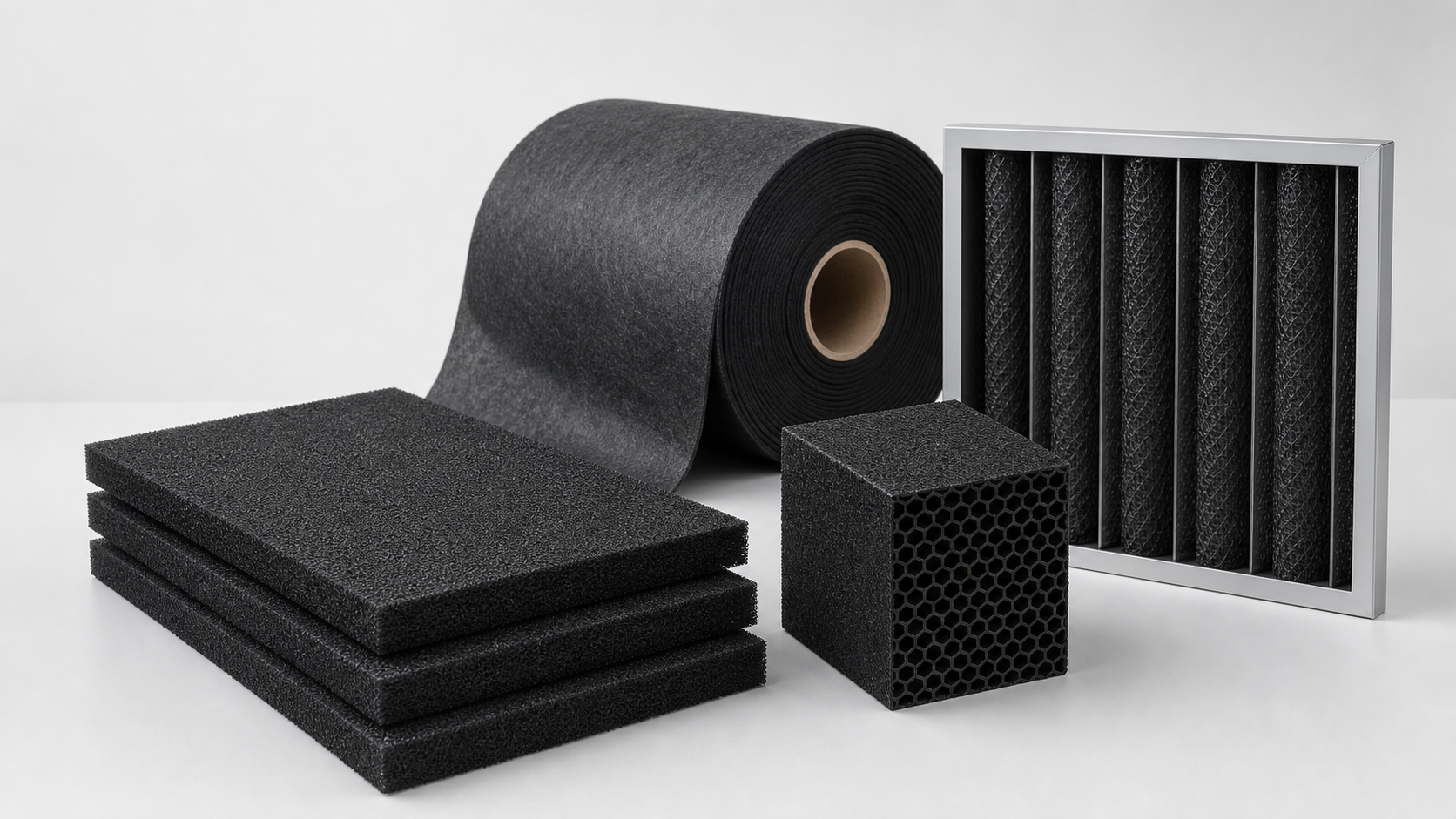
Activated carbon sandwich nonwoven fabric, activated carbon fiber felt and honeycomb activated carbon foam are designed for different filter structures. There is no universal “best” material. The correct choice depends on the target pollutant, airflow, available installation space, required component shape and downstream manufacturing process.
Activated carbon works by adsorption: gaseous pollutants are transferred from the air stream to the solid surface of the adsorbent. The U.S. Environmental Protection Agency notes that adsorption capacity is finite, so service life and replacement planning must be considered as part of the complete filter design.
Material 01
Activated Carbon Sandwich Nonwoven Fabric
Activated carbon sandwich nonwoven fabric holds granular activated carbon between supporting nonwoven layers. This construction helps contain the carbon while keeping the material flexible for filter conversion.
- Supply form: roll, sheet or cut pad
- Structure: granular carbon between nonwoven layers
- Applications: air purifier, HVAC, fresh-air and odor-control filters
- Conversion: slitting, lamination and die cutting
This format is suitable when a filter design needs a relatively thin, flexible carbon-containing layer that can be processed together with supporting media. Buyers should specify roll width or sheet dimensions, basis weight, carbon loading, lamination structure and required cut size.
Material 02
Activated Carbon Fiber Felt
Activated carbon fiber felt is a flexible fibrous adsorption medium. It can be supplied in rolls or sheets, layered, cut or converted into cartridges and other filter components.
- Supply form: roll or sheet
- Material: viscose-based activated carbon fiber felt
- Applications: VOC adsorption, odor control and industrial filtration
- Conversion: layering, cutting and cartridge development
The confirmed thickness range is 0.8–4.5 mm. Final selection should also consider the target VOC or odor source, required width, airflow, installation structure, temperature, humidity and component conversion method.
Material 03
Honeycomb Activated Carbon Foam Filter
Honeycomb activated carbon foam filter uses open-cell polyurethane foam as the carrier for powdered activated carbon. The porous structure can be supplied as sheets or custom-cut components.
- Supply form: foam sheet or cut pad
- Structure: polyurethane foam with powdered activated carbon
- Applications: air purifier, ventilation, fume and odor-control filters
- Conversion: sheet cutting and custom component shaping
Confirmed options include 20, 30 and 35 PPI pore densities and thicknesses from 3 to 100 mm. Selection should be based on airflow, installation space, required dimensions, target odor or VOC and whether a flame-retardant option is needed.
Key differences at a glance
| Selection factor | Sandwich nonwoven | ACF felt | Carbon foam |
|---|---|---|---|
| Basic structure | Granular carbon between nonwoven layers | Fibrous activated carbon felt | Open-cell PU foam with powdered carbon |
| Common format | Roll, sheet or cut pad | Roll, sheet or converted component | Sheet or cut component |
| Typical conversion | Slitting, lamination and die cutting | Layering, cutting and cartridge conversion | Cutting and component assembly |
| Typical use | HVAC, air purifier and fresh-air filters | VOC, industrial exhaust and adsorption components | Air purifier, ventilation and compact modules |
Which material should you choose?
Choose activated carbon sandwich nonwoven when the design requires a flexible carbon layer that can be laminated, slit or die-cut.
Choose activated carbon fiber felt when the project requires a fibrous adsorption medium for layering, cartridge conversion or industrial VOC and odor-control components.
Choose activated carbon foam when the filter requires a porous sheet or custom-cut component with selectable pore density and thickness.
Activated carbon media is mainly selected for gas-phase adsorption and odor control. If the incoming air also contains dust or particles, a suitable particulate pre-filter should be considered before the carbon stage.
Information to send before requesting a sample
- Filter application or equipment type
- Target odor, VOC or gas-phase contaminant
- Required roll, sheet or finished-component format
- Length, width, thickness and available installation space
- Operating airflow, temperature and humidity
- Required lamination, cutting, frame or sealing structure
- Product drawing or reference sample, when available
If some specifications are not yet confirmed, describe the current application and equipment structure. Junkang Filter Media can introduce the available factory product formats for evaluation.
Technical reference
General adsorption principles referenced in this guide are consistent with the U.S. Environmental Protection Agency’s overview of activated carbon adsorbers.
U.S. EPA: Activated Carbon Adsorber Monitoring and Control Technique